
A business question should not lead to another manual search
When someone asks how sales are progressing, which customers reduced their purchases or which orders remain pending, finding the answer often requires navigating several applications, filtering information and rebuilding the context.
This approach connects artificial intelligence, MCP and JD Edwards Orchestrator to turn that request into a management-ready response that is understandable, traceable and actionable.
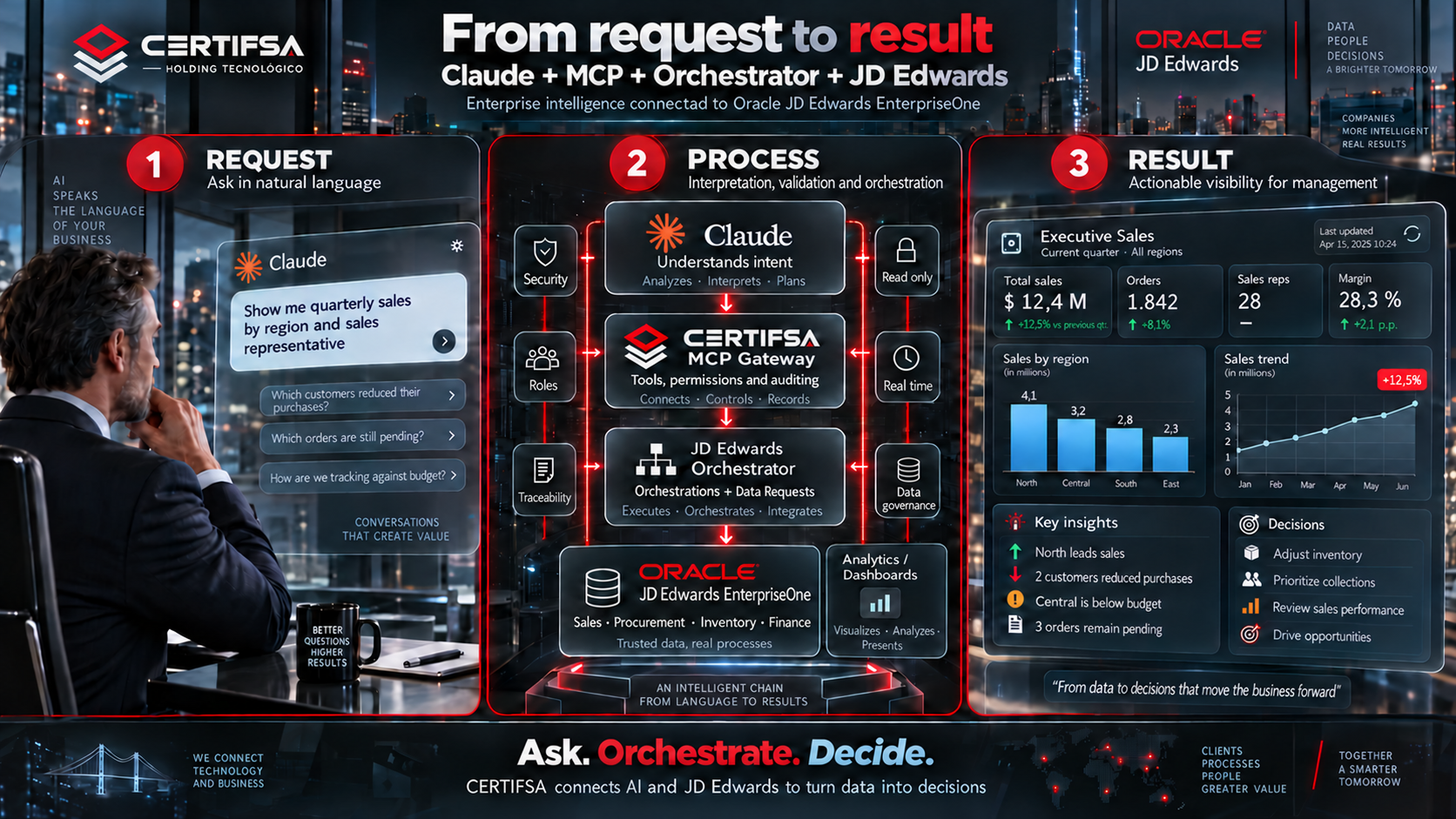
1. The request: speak the language of the business
The user asks a question in natural language. Claude interprets the intent, identifies the relevant dimensions —company, business unit, period, region, customer, product or owner— and prepares a structured request.
Conversation makes information easier to access, but it does not remove system rules or grant unrestricted access.
2. The process: control before execution
The CERTIFSA MCP Gateway acts as a governance layer between the artificial intelligence model and enterprise services. It defines available tools, permissions, roles, read-only operations, audit records and security controls.
JD Edwards Orchestrator receives authorized requests and executes the queries or processes designed for EnterpriseOne. The architecture prevents the AI from operating directly on the database: every interaction uses predefined, verifiable capabilities aligned with the organization's technology governance.
3. The result: information ready for decisions
The response can be presented as a management cockpit with indicators, comparisons, trends, exceptions and suggested actions. The goal is not to provide more data, but to explain what is happening and help determine what needs attention.
This approach can support sales, procurement, inventory, finance, receivables, production, maintenance, logistics, projects and many other processes managed in JD Edwards.
Security, traceability and context
An enterprise AI solution needs more than an attractive conversation. It requires identity, role-based permissions, request traceability, data protection, execution boundaries and auditing.
Each implementation is therefore designed around the EnterpriseOne version, infrastructure, processes, security policies and use cases of the organization. The image represents a conceptual architecture; the final configuration depends on the customer's environment.
Asking is only the beginning. Value appears when the answer preserves context, control and the ability to act.
Start with one concrete decision
CERTIFSA can identify a recurring management question, connect the required sources through Orchestrator and build an initial use case with measurable results. The capability can then expand progressively to additional processes and roles.